Table of Contents
- The 200 Square Foot Rule (And Why It's Not That Simple)
- Understanding Colorado Permits: Zoning vs. Building
- Colorado Permits for Sheds
- Colorado Permits for Greenhouses
- Product Embed | Barrel Outdoor Sauna | 6 PersonColorado Permits for Saunas
- How Foundation Type Affects Colorado Permits
- Don't Forget Your HOA
- Colorado Permits: Quick Reference by Jurisdiction
- What Happens If You Skip the Permit?
- Questions to Ask Your Building Department
- How South Table Sheds Can Help
- FAQs
Colorado Building Permits for Sheds, Greenhouses & Saunas: What You Need to Know
A Complete Guide from South Table Sheds | 17 Years Experience
If you're planning to add a shed, greenhouse, or sauna to your Colorado property, one of the first questions you'll face is: Do I need a permit to build on my property in Colorado?
The answer depends on where you live, what you're building, and how you're building it. Colorado building permits are handled at the local level, which means requirements vary significantly from Denver to Jefferson County to Colorado Springs. After 17 years of helping Front Range homeowners navigate these requirements, we've learned that a little research upfront saves a lot of headaches later.
This guide covers what you need to know about Colorado building permits for backyard structures, including some surprises that catch homeowners off guard.
The 200 Square Foot Rule (And Why It's Not That Simple)
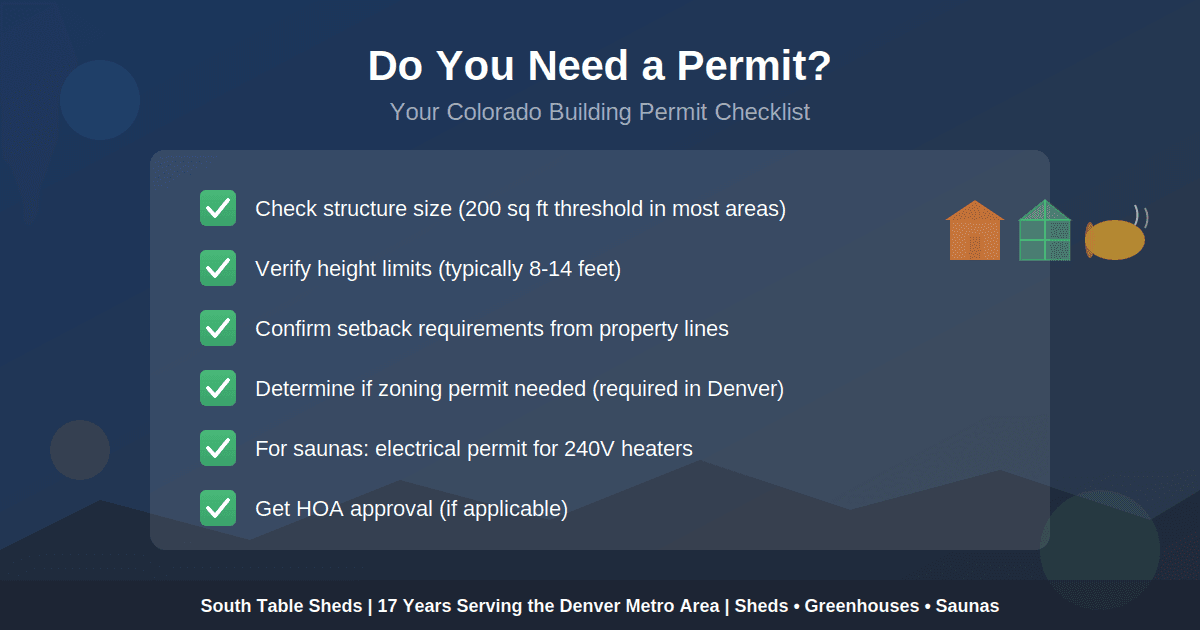
Across most Colorado jurisdictions, 200 square feet is the magic number. Detached accessory structures under this threshold typically don't require a building permit. This applies to sheds, greenhouses, and sauna structures alike.
But here's where it gets complicated:
Height matters too. Most jurisdictions also have height limits for permit-exempt structures, typically 8 to 14 feet depending on the area. A tall greenhouse or two-story shed might trigger permit requirements even if it's under 200 square feet.
Denver is different; and more layered than a flat rule. A building permit isn't required for a one-story, non-conditioned shed under 200 square feet and 14 feet tall (non-conditioned means no heat or A/C — two lights and two receptacles are allowed under a separate electrical permit without triggering this one). But a zoning permit may still apply on top of that. Whether it does depends on your zone district: in most of Denver's current zoning districts, you're exempt only if your shed qualifies as a "minor detached structure" under the city's building form standards. In older Chapter 59 zone districts, a zoning permit is required no matter the size. Check both boxes separately
Boulder County is stricter. Boulder County only exempts structures up to 120 square feet, not the typical 200.
Colorado Springs adds zoning review. While structures under 200 square feet don't need a building permit, anything 125 square feet or larger requires zoning approval in Colorado Springs city limits.
Jefferson County has cumulative limits. JeffCo caps "mini-structures for storage" at a cumulative 200 square feet total. If you already have a 150 square foot shed, adding another 100 square foot structure would exceed the limit.
Understanding Colorado Permits: Zoning vs. Building
One common source of confusion: there are actually two types of permits to consider.
Zoning permits govern WHERE you can build. They ensure your structure meets setback requirements (distance from property lines), lot coverage limits, and land use regulations. Even permit-exempt structures must comply with zoning rules.
Building permits govern HOW you build. They ensure structural integrity, proper foundations, and compliance with building codes for wind loads, snow loads, and safety.
A structure might be exempt from building permits but still require zoning review—or vice versa. Always check both.
Colorado Permits for Sheds
Storage and Garden sheds are the most straightforward of the three structure types, but there are still nuances to understand.
When You Typically DON'T Need a Building Permit:
• Detached shed under 200 square feet (120 sq ft in Boulder County)
• Single-story with height under local limits (usually 8-14 feet)
• Placed on grade or gravel pad (not permanent foundation)
• Used strictly for storage (not habitation or workspace)
When You Likely WILL Need a Building Permit:
• Shed over 200 square feet
• Shed with electrical wiring
• Shed on a concrete foundation
• Attached to your home or garage
• Located in Denver and conditioned with heat or A/C (loses the building permit exemption regardless of size)
• Located in Denver outside a zone district's "minor detached structure" exemption (triggers a zoning permit separately from the building permit, check your specific zone district)
Pro tip: Even if your shed doesn't need a permit, it must still meet setback requirements. Most jurisdictions require structures to be a certain distance from property lines, typically 3 to 5 feet for side and rear setbacks, more for front yards.
Large Polycarbonate Greenhouse | Exaco RIGA
$5,859.00
$6,899.00
RIGA Series Greenhouse Kit FREE SHIPPING (lower 48) All polycarbonate panels (8mm sides, 10mm gable ends) Complete aluminum frame with all extrusions and connectors Barn-style hinged door with key lock (30" W × 72" H) Roof ventilation window(s) with automatic… read more

Colorado Permits for Greenhouses
Greenhouses follow similar rules to sheds, but with a few important distinctions.
Freestanding vs. Attached A Critical Difference
This is the biggest factor for greenhouse permits in Colorado:
Freestanding greenhouses are treated as accessory structures. Under 200 square feet, they typically don't require a building permit (same rules as sheds).
Attached greenhouses (lean-to style against your home) are treated as home additions. They require full building permits regardless of size, including structural review and potentially impacting your home's heating and cooling systems.
A Special Note on Greenhouses in Denver
Denver's building permit exemption is written for "tool and storage sheds, playhouses, and similar uses" that are non-conditioned. A greenhouse isn't explicitly named in that list, which leaves some real ambiguity about whether it qualifies. It matters even more if your greenhouse uses supplemental heat or venting equipment to protect plants, since that likely makes it "conditioned," which would remove the building permit exemption regardless of size.
Because this isn't clearly spelled out in the city's own guidance, our advice for Denver greenhouse owners is simple: call Denver Community Planning and Development directly before you build, rather than assuming your greenhouse is treated exactly like a storage shed. It's a quick call, and it can save you from a costly correction later.
Looking for a greenhouse? Read our post on how much a greenhouse costs in Colorado
Colorado-Specific Considerations
Snow loads: Colorado's Front Range requires structures to handle significant snow loads, minimum 30 pounds per square foot in most areas. For larger greenhouses requiring permits, you may need engineered drawings demonstrating compliance.
Wind loads: Many Front Range areas have wind speed requirements of 115+ mph for structural calculations.
Agricultural exemptions: Some rural areas and agricultural zone districts have exemptions for farm structures. If you're on agricultural land, ask your building department about potential exemptions.
Not sure which greenhouse is right for your Colorado property? Read our guide to the best greenhouse for Colorado: hail, wind, and altitude.
Barrel Outdoor Sauna - 6 Person w/ Harvia KIP 8kW Heater
$6,599.00
Start your day with mental clarity and relaxation in this beautifully crafted barrel sauna. Designed for backyard bliss, it delivers an authentic sauna experience while enhancing your outdoor space. Built from premium heat-treated hemlock, it combines natural beauty with lasting… read more
 Colorado Permits for Saunas
Barrel Outdoor Sauna - 6 Person w/ Harvia KIP 8kW Heater
$6,599.00
Start your day with mental clarity and relaxation in this beautifully crafted barrel sauna. Designed for backyard bliss, it delivers an authentic sauna experience while enhancing your outdoor space. Built from premium heat-treated hemlock, it combines natural beauty with lasting… read more

Saunas are where Colorado permits get interesting. The structure itself follows the same 200 square foot rule, but the heater introduces additional requirements.
Electric Sauna Heaters
Most traditional sauna heaters require 240V electrical service. This means:
• Electrical permit required in virtually all Colorado jurisdictions
• Installation must be done by a licensed electrician
• Inspection required before use
The good news: electric heaters don't require EPA certification or face air quality restrictions. We offer Harvia KIP electric heaters that provide an authentic traditional sauna experience without the regulatory complications of wood-burning options.
Wood-Burning Sauna Stoves
Wood-burning saunas face additional hurdles in Colorado:
Mechanical permit required: Wood stove installation typically requires a mechanical permit and inspection.
Air quality regulations: In the seven-county Denver metro area (Denver, Boulder, Broomfield, Douglas, Jefferson, and portions of Adams and Arapahoe counties below 7,000 feet), wood-burning devices must be EPA Phase III certified. Many popular Finnish sauna stoves are NOT EPA certified.
Action Day restrictions: Non-certified wood-burning devices cannot be used during air quality Action Days (November through March).
Mountain exemption: Properties above 7,000 feet elevation are exempt from these restrictions, making wood-burning saunas more practical in mountain communities like parts of Evergreen and Conifer.
How Foundation Type Affects Colorado Permits
The type of foundation you choose can significantly impact permit requirements for any backyard structure.
Gravel pad or placed on grade: Treated as temporary or accessory structures. This is the easiest path for permit-exempt sheds, greenhouses, and saunas under 200 square feet.
Concrete slab: A permanent foundation often triggers permit requirements regardless of structure size. Some jurisdictions require a permit for the concrete work itself before you even build the structure.
Attached to existing structure: Any structure attached to your home—whether a lean-to greenhouse, shed addition to a garage, or indoor sauna conversion—is treated as a home addition requiring full building permits.
For most customers, we recommend freestanding structures on gravel pads. It simplifies the permit process and gives you flexibility to relocate the structure later if needed.
Don't Forget Your HOA
Colorado permits are only part of the equation. If you live in a community with a homeowners association, you'll likely need architectural approval—and HOA rules can be stricter than local building codes.
• HOAs can restrict structure size, placement, materials, and colors
• Some prohibit certain structure types entirely
• Wood-burning saunas often face extra scrutiny due to smoke
• Approval can take 30-60 days or more
Critical advice: Always get written HOA approval BEFORE purchasing any backyard structure. We've seen too many homeowners buy a shed or greenhouse only to have their HOA reject it after the fact.
Colorado Permits: Quick Reference by Jurisdiction
Here's a snapshot of requirements across major Front Range areas:
Denver
• Building permit not required for a one-story, non-conditioned shed under 200 sq ft and 14 ft tall (two lights/two receptacles allowed under a separate electrical permit)
• Building permit required if over 200 sq ft, over 14 ft tall, or conditioned (heat/AC)
• Zoning permit required unless your shed qualifies as a "minor detached structure" in your zone district (older Chapter 59 districts require it regardless of size)
• Air quality restrictions on wood-burning devices
Jefferson County (Unincorporated)
• No building permit for structures under 200 sq ft and under 14 ft tall
• Cumulative 200 sq ft limit on mini-structures
• Mountain areas may require Defensible Space Permit
Golden
• No building permit for detached structures under 200 sq ft
• Pools, hot tubs, spas require permits
Colorado Springs / Pikes Peak Region
• No building permit for structures under 200 sq ft
• Zoning approval required if 125 sq ft or larger (city limits)
• Outside Denver metro air quality restricted area
Fort Collins / Larimer County
• Prefab structures typically don't require building permits if under 200 sq ft
• Outside Denver metro air quality restricted area
Boulder County
• More restrictive: only 120 sq ft exempt
• Structures with utilities typically require permits
• 12 ft height limit for exempt structures
Apple Outdoor Supply 14x27 Shed Windows, Flush Mount Sliding Windows with Tempered Glass & Screens, 2-Pack
$118.00
$130.00
Upgrade your shed, chicken coop, playhouse, outdoor storage building, backyard office, or DIY structure with this Apple Outdoor Supply 14x27 flush mount sliding shed window. This 2-pack includes tempered glass, screens, aluminum frames, and installation hardware. Designed to add natural… read more

What Happens If You Skip the Permit?
We understand the temptation to skip the paperwork, but here's why it's not worth the risk:
Stop work orders: If inspectors notice unpermitted construction, work stops until permits are obtained.
Sale complications: Unpermitted structures discovered during home inspections can derail real estate transactions.
Insurance issues: Damage to or caused by unpermitted structures may not be covered. This is especially critical for saunas with unpermitted electrical work.
Forced removal: In worst cases, you may be required to remove non-compliant structures entirely.
Retroactive permitting: Getting permits after the fact is often more expensive and complicated than doing it right the first time.
Questions to Ask Your Building Department
Before purchasing any backyard structure, call your local building department with these questions:
1. What's the maximum size for a permit-exempt accessory structure?
2. Are there height restrictions?
3. What are the setback requirements for my property's zoning?
4. Do I need a zoning permit even if no building permit is required?
5. Is my property in any overlay districts (flood plain, historic, wildfire)?
6. For saunas: Do I need an electrical permit for a 240V heater?
7. For saunas: Are there air quality restrictions on wood-burning devices?
8. For greenhouses: Does an attached greenhouse require different permits than freestanding?
Pro tip: Know your property's zoning designation before you call. Most Colorado counties have online maps where you can look this up.
How South Table Sheds Can Help
At South Table Sheds, we've spent years helping Denver metro homeowners navigate Colorado permits for outdoor structures. While we guide you through the research process, homeowners handle the actual permit filing, which ensures you're working directly with your local jurisdiction.
Here's what we provide:
• Help identifying which jurisdiction governs your property
• Consult for permit applications
• Knowledge of common requirements across Front Range municipalities
• Guidance on placement to comply with typical setback requirements
• For saunas: electric heater options that simplify the permit process
Whether you're looking for a storage shed, a greenhouse to extend your growing season, a backyard sauna for year-round relaxation, or a backyard office, we're here to help you do it right.
Contact us to discuss your project, or browse our selection of sheds, shed accessories, greenhouses, and saunas online.
South Table Sheds
Serving the Denver Metro Area for 17 Years
Sheds | Greenhouses | Saunas | Cold Plunges
FAQs
1. Do I need a permit for a shed under 200 square feet in Colorado?
In most Colorado jurisdictions, detached sheds under 200 square feet do not require a building permit, but there are exceptions. Boulder County has a stricter 120 square foot limit, and exempt structures cannot have utilities. Even permit-exempt sheds must comply with setback requirements, so always check with your local building department before purchasing.
2. What's the difference between a zoning permit and a building permit?
Zoning permits govern where you can build on your property, including setback requirements (distance from property lines) and lot coverage limits. Building permits govern how you build, ensuring structural integrity and code compliance. A structure might be exempt from building permits but still require zoning approval—Denver is a good example, where all accessory structures need zoning permits even if no building permit is required.
3. Do I need a permit for an outdoor sauna in Colorado?
The sauna structure itself follows the same 200 square foot rule as sheds and greenhouses. However, sauna heaters introduce additional requirements. Electric heaters (240V) require an electrical permit and licensed installation in all Colorado jurisdictions. Wood-burning stoves require a mechanical permit and must be EPA Phase III certified in the Denver metro area. Properties above 7,000 feet elevation are exempt from wood-burning restrictions.
4. Does an attached greenhouse require a permit?
Yes. Attached greenhouses (lean-to style against your home) are treated as home additions and require full building permits regardless of size. Freestanding greenhouses follow the standard accessory structure rules—under 200 square feet typically doesn't require a building permit in most jurisdictions. This is one of the most common surprises for Colorado homeowners planning a greenhouse project.
5. What happens if I build without a required permit in Colorado?
Building without required permits can result in stop work orders, forced removal of the structure, complications when selling your home, and insurance issues—especially for saunas with unpermitted electrical work. Retroactive permitting is often more expensive and complicated than doing it right the first time. A quick call to your local building department before you buy can save significant headaches later.