Table of Contents
- Why Colorado Is One of the Hardest Climates for Greenhouses
- What to Look for in a Colorado Greenhouse
- Panel Thickness and Snow Load Rating
- Frame Strength and Material
- Roof Profile for Wind and Snow Shedding
- UV-Protected Glazing
- Ventilation for Colorado's Intense Summer Sun
- How the Riga Handles Colorado's Biggest Threats
- Hail Resistance
- Wind Performance
- Snow Load Performance
- UV Protection
- German Engineering for Long-Term Performance
- Which Riga Is Right for Your Colorado Property?
- Financing Available
- Denver Area? Add Professional Assembly
- Frequently Asked Questions
- FAQs
If you're shopping for a greenhouse in Colorado, you're shopping for a structure that needs to survive hail the size of golf balls, chinook winds gusting past 60 mph, intense UV at 5,000+ feet, and temperature swings that can drop 40 degrees in an afternoon.
Most greenhouse kits on the market weren't designed with any of that in mind. Here's what to actually look for and why Colorado gardeners keep coming back to the Riga, which is our suggestion as the best greenhouse for Colorado.
Why Colorado Is One of the Hardest Climates for Greenhouses
Colorado looks like paradise for gardeners on a sunny May morning. But the Front Range throws challenges that most greenhouse manufacturers never consider:
Hail. Colorado sits in "Hail Alley" — one of the most hail-prone regions in the world. The Denver metro and Front Range see significant hail events every single season. A greenhouse that can't handle impact isn't a greenhouse — it's a temporary structure.
Wind. Chinook winds roll off the Rockies with little warning, regularly gusting above 60 mph along the foothills from Fort Collins to Pueblo. Flat-sided, thin-framed greenhouses can collapse or deform under sustained wind loads.
Snow load. Wet Colorado spring snow is heavy. A structure rated for light powder won't hold up under a March snowstorm that drops 12 inches of wet, dense snow overnight. Snow load rating matters — and most kit greenhouse manufacturers don't publish theirs.
UV intensity. At Colorado's elevation, UV radiation is 25–50% more intense than at sea level. Polycarbonate panels without proper UV coating degrade rapidly — yellowing, cracking, and losing light transmission within 2–3 years.
Temperature swings. A March afternoon can start at 60°F and end with 8 inches of wet snow. Expansion and contraction cycles stress frames, seals, and panels. Quality construction handles this — budget construction doesn't.
Riga 3 Greenhouse | 102 sq. ft.| Hoklartherm

$6,899.00
What's Included Every Riga 3 ships as a complete kit: All polycarbonate panels (8mm sides, 10mm gable ends) Complete aluminum frame with all extrusions and connectors Barn-style hinged door with key lock (30" W x 79" H) 1 roof ventilation… read more
What to Look for in a Colorado Greenhouse
Panel Thickness and Snow Load Rating
The minimum you should consider for Colorado is 8mm twin-wall polycarbonate. Single-wall panels (4–6mm) common on big-box store greenhouses offer minimal insulation and significantly less impact resistance under hail and snow.
Twin-wall panels trap an insulating air layer that helps retain heat overnight and cushions impact. For serious snow country, 10mm twin-wall or 16mm triple-wall panels offer even better structural performance.
Snow load rating is the spec most buyers overlook. Look for a greenhouse rated for at least 15–20 lbs per square foot of snow load for Front Range conditions. Higher elevation properties, especially on the western slope or in mountain communities, should look for 25+ lbs/sq ft.
Frame Strength and Material
Heavy-gauge anodized aluminum is the benchmark, not thin-wall tubing. A 13-gauge aluminum frame handles snow load, wind load, and decades of Colorado freeze-thaw cycles without loosening, corroding, or deforming. Thinner than that and you're gambling on longevity.
Roof Profile for Wind and Snow Shedding
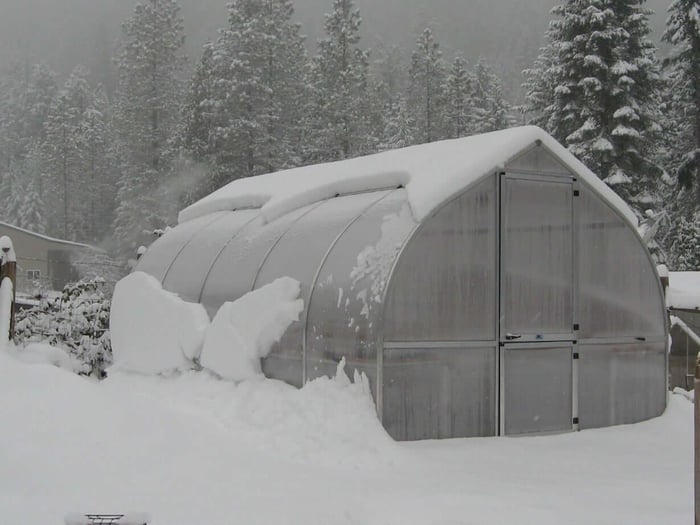
A flat roof collects snow and catches wind. A curved or pitched roof sheds both. This is one of the most overlooked factors in greenhouse selection and one of the most important for Colorado buyers. An aerodynamic curved roof that redirects wind and sheds snow naturally is worth far more than a slightly larger footprint on a flat-roofed alternative.
UV-Protected Glazing
Any polycarbonate panels you consider should carry an explicit UV protection rating and warranty. Without it, you'll be replacing panels within 3–4 years at Colorado's elevation. Look for a minimum 10-year UV warranty.
Ventilation for Colorado's Intense Summer Sun
Colorado's high-altitude sun can push greenhouse temperatures well above 100°F on summer afternoons. Automatic roof vents that open based on temperature — not a timer or app — are essential for preventing heat damage to plants without constant babysitting.
How the Riga Handles Colorado's Biggest Threats
[IMAGE 2: Close-up of Riga twin-wall polycarbonate panels or curved roof profile]
We've sold and assembled Riga greenhouses across the Front Range for years. Here's how they perform against Colorado's specific challenges:
Hail Resistance
The Riga's 8mm and 10mm twin-wall polycarbonate panels absorb and distribute impact rather than concentrating stress at one point. The curved roof profile means hailstones strike at an angle rather than straight-on, further reducing impact force. Customers report Riga greenhouses coming through significant Front Range hailstorms intact while neighboring budget greenhouses required complete panel replacement.
Wind Performance
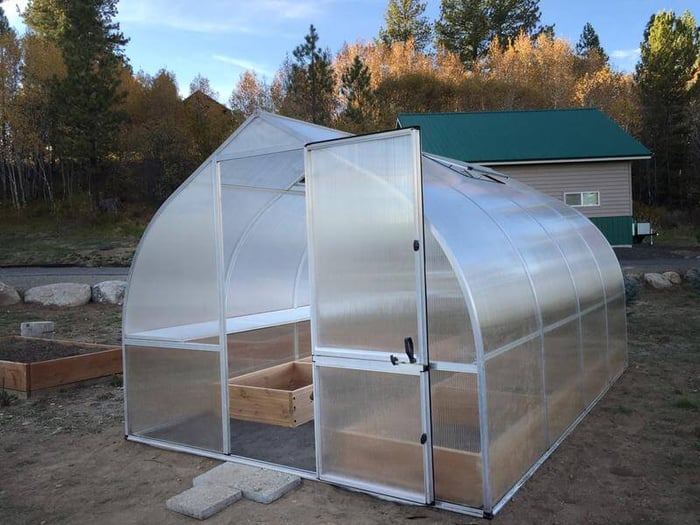
The Riga's bell-shaped curved roof redirects wind up and over the structure rather than catching it on flat surfaces. Customers in the Sierra Nevada, coastal New England, and the Great Plains, areas with documented 100 mph wind events, report the Riga holding up without structural damage. On Colorado's Front Range, where chinook gusts regularly exceed 60 mph, this aerodynamic advantage is meaningful.
Snow Load Performance
The curved roof profile sheds snow naturally rather than allowing it to accumulate. The 13-gauge aluminum frame and heavy-duty polycarbonate panels are engineered to handle significant snow load. We always recommend clearing heavy accumulated snow as a precaution, but the Riga's profile significantly reduces buildup compared to flat or gently pitched alternatives.
UV Protection
Riga panels carry a 10-year warranty against UV degradation, one of the stronger warranties in the category. At Colorado's elevation, that protection is doing real work from day one.
German Engineering for Long-Term Performance
The Riga is manufactured by Hoklartherm in Germany, a company that has been building greenhouses for over 30 years. Every hole lines up. Every connector seats properly. The 13-gauge anodized aluminum frame carries a 15-year warranty. This is a structure built to last decades, not seasons.
Aerobin Outdoor Compost Bin

$459.00
Aerobin Outdoor Compost Bin Turn Waste Into Gold—No Turning Required Sold by South Table Sheds Effortless Composting for the Modern Gardener Say goodbye to backbreaking turning and foul odors. The Aerobin Outdoor Compost Bin is the first composter designed for… read more
Which Riga Is Right for Your Colorado Property?
Riga S Series — Best for Suburban Front Range Lots
7'8" wide | 7'1" peak height | 54–108 sq ft | From $5,999
The entry point for serious growing. Three sizes to choose from, all sharing the same 7'8" width and 7'1" peak height. Perfect for Denver metro and suburban Front Range properties where space is limited but performance can't be compromised.
- Riga 2s — 54 sq ft, 7'8" x 7' — $5,999
- Riga 3s — 81 sq ft, 7'8" x 10'6" — $6,599
- Riga 4s — 108 sq ft, 7'8" x 14' — $7,399
Riga Large Series — Best for Serious Home Gardeners
9'8" wide | 7'7" peak height | 102–165 sq ft | From $6,899
More width, more headroom, taller door (79"). The step up for gardeners who want two full growing benches with a genuine center aisle. Popular with Colorado growers who want year-round production and enough room to work comfortably.
- Riga 3 — 102 sq ft, 9'8" x 10'6" — $6,899
- Riga 4 — 135 sq ft, 9'8" x 14' — $8,099
- Riga 5 — 165 sq ft, 9'8" x 17'6" — $9,199
Riga XL Series — Best for Serious Growers and Large Properties
14' wide | 9'10" peak height | 280 sq ft | From $18,499
Professional-grade growing infrastructure with 16mm triple-wall glazing, dual barn doors, and nearly 10 feet of peak height. For serious growers, hobby farmers, and properties where the greenhouse is a centerpiece investment.
- Riga XL 6 — 280 sq ft, 14' x 19'10" — $18,499
Financing Available
A Riga greenhouse is a long-term investment in your property and your growing operation. Shop Pay installments are available at checkout and break your purchase into manageable payments with no hidden fees. A Riga 3s at $6,599 works out to around $550/month on a 12-month plan.
Denver Area? Add Professional Assembly
Every Riga ships as a ready-to-assemble kit, but if you'd rather focus on growing than spend a weekend with an instruction manual, we offer professional assembly across the Denver metro and Front Range. South Table Sheds has been building structures in Colorado and knows exactly how to anchor a Riga for our wind conditions, level it for Colorado's drainage challenges, and orient it for our specific sun angle.
Getting started is simple:
- Choose your Riga size and options
- Purchase online with free shipping to the lower 48
- We deliver and assemble at your property (Denver area)
- Start growing
Frequently Asked Questions
Will a Riga greenhouse survive Colorado hail?
The Riga's twin-wall polycarbonate panels, 8mm on side walls and 10mm on gable ends, offer significantly better impact resistance than the single-wall panels on budget greenhouse kits. The curved roof profile means hail strikes at an angle rather than straight-on. While no greenhouse can guarantee zero damage in an extreme hail event, the Riga consistently outperforms competing kits in impact resistance and carries a 10-year panel warranty.
How does the Riga handle Front Range wind?
The Riga's aerodynamic curved roof profile redirects wind up and over the structure rather than catching it on flat surfaces. Customers in high-wind regions report the Riga holding up through wind events well above 60 mph without structural damage. For maximum stability in Colorado's chinook conditions, we recommend anchoring to a solid foundation rather than unanchored soil.
What snow load can the Riga handle?
The Riga's curved roof sheds snow naturally rather than allowing accumulation. The 13-gauge aluminum frame and heavy-gauge polycarbonate panels are engineered for significant snow load. We recommend clearing heavy wet snow as a precaution, a practice any responsible greenhouse owner in Colorado should follow regardless of the structure they own.
Do I need a permit for a greenhouse in Colorado?
Most Front Range municipalities don't require permits for structures under 120–200 square feet, which covers most Riga S and Large series models. Rules vary by city and HOA. For a full breakdown by municipality, see our Colorado greenhouse and shed permit guide.
Can I heat a Riga for year-round growing in Colorado?
Yes, and the twin-wall panels make it efficient. Many Colorado growers maintain above-freezing temperatures through our coldest nights with a small electric or propane heater. Customers in New Mexico at 7,800 feet report growing vegetables year-round, including fresh tomatoes in winter.
How long does assembly take?
Plan a full day with two people for a first build, roughly 8–10 hours. Or skip it entirely with our professional assembly service across the Denver metro and Front Range.
What can I grow in a Greenhouse in Colorado? Check out our article on what you can grow and when in a greenhouse in Colorado.
South Table Sheds is an authorized Exaco dealer based in Golden, Colorado. We sell and assemble Riga greenhouses across the Denver metro and Front Range. Questions before you buy? Call us at 720-656-7313 or contact us here.
FAQs
Will a Riga greenhouse survive Colorado hail?
The Riga's twin-wall polycarbonate panels, 8mm on side walls and 10mm on gable ends, offer significantly better impact resistance than the single-wall panels on budget greenhouse kits. The curved roof profile means hail strikes at an angle rather than straight-on. While no greenhouse can guarantee zero damage in an extreme hail event, the Riga consistently outperforms competing kits in impact resistance and carries a 10-year panel warranty.
How does the Riga handle Front Range wind?
The Riga's aerodynamic curved roof profile redirects wind up and over the structure rather than catching it on flat surfaces. Customers in high-wind regions report the Riga holding up through wind events well above 60 mph without structural damage. For maximum stability in Colorado's chinook conditions, we recommend anchoring to a solid foundation rather than unanchored soil.
What snow load can the Riga handle?
The Riga's curved roof sheds snow naturally rather than allowing accumulation. The 13-gauge aluminum frame and heavy-gauge polycarbonate panels are engineered for significant snow load. We recommend clearing heavy wet snow as a precaution, a practice any responsible greenhouse owner in Colorado should follow regardless of the structure they own.
Do I need a permit for a greenhouse in Colorado?
Most Front Range municipalities don't require permits for structures under 120–200 square feet, which covers most Riga S and Large series models. Rules vary by city and HOA. For a full breakdown by municipality, see our Colorado greenhouse and shed permit guide.
Can I heat a Riga for year-round growing in Colorado?
Yes, and the twin-wall panels make it efficient. Many Colorado growers maintain above-freezing temperatures through our coldest nights with a small electric or propane heater. Customers in New Mexico at 7,800 feet report growing vegetables year-round, including fresh tomatoes in winter.
How long does assembly take?
Plan a full day with two people for a first build, roughly 8–10 hours. Or skip it entirely with our professional assembly service across the Denver metro and Front Range.