Table of Contents
- Is It Worth Getting an Outdoor Sauna? A Colorado Perspective
- Is an Outdoor Sauna a Good Idea?
- What Is the 200 Rule for Saunas?
- Wet Sauna vs. Dry Sauna? What's the Difference, and Which Is Right for Colorado?
- Do I Need a Permit to Put a Sauna in My Backyard?
- What We Have Seen: The Most Common Backyard Challenges
- The Outdoor Shower Factor
- Our Sauna Collection: What We Sell and What We Recommend
- What we recommend for most buyers:
- Is It Worth Getting an Outdoor Sauna? Our Honest Take.
- FAQs
 Is It Worth Getting an Outdoor Sauna? A Colorado Perspective
If you've been thinking about an outdoor sauna, you're probably asking yourself one honest question: is a sauna actually worth it? Not the glossy version, the real answer, including cost, practicality, and whether you'll actually use it.
We're South Table Sheds, based in Golden, Colorado. We sell and assemble outdoor saunas throughout the Denver metro and Front Range, and our builders have 17+ years of construction experience, over 10+ years in Colorado. Here's what we think you should know before you buy.
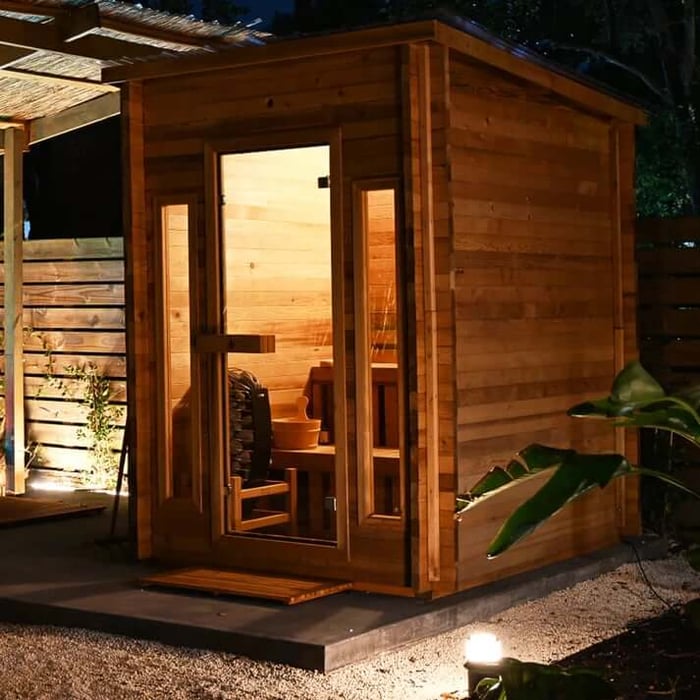
Cabin Outdoor Sauna - 4 Person w/ Harvia Spirit Wi-Fi 8kW Heater

$9,299.00
Maximize your outdoor space with The Cabin Sauna, the perfect solution for small backyards. Designed to fit seamlessly into limited areas, this compact sauna doesn't compromise on comfort or functionality. Its two-level seating allows you to effortlessly cycle between high… read more
Is an Outdoor Sauna a Good Idea?
For the right person, absolutely. For someone who commits to using it regularly and sets it up thoughtfully, an outdoor sauna becomes one of the most-used investments in their home. For someone who treats it as an impulse purchase and plops it in a distant corner of the yard, it can become an expensive conversation piece. Outdoor saunas typically range from $6,000–$10,000 depending on size and heater option, a one-time investment that replaces ongoing gym or spa costs for years.
We recommend using your sauna at least two times a week and making it part of an existing routine. Either your post-workout recovery, your morning ritual, or your evening wind-down. When it becomes part of your day rather than a separate effort, it sticks.
The customers who get the most out of their saunas are health-conscious homeowners who are already active. Colorado has a massive athlete community including cyclists, trail runners, skiers, climbers. A sauna fits naturally into that lifestyle. Recovery is a real performance variable, and regular heat therapy is one of the most effective tools for it.
What Is the 200 Rule for Saunas?
The "200 rule" is a general guideline that says the temperature (in °F) plus the humidity percentage should add up to around 200 for an optimal sauna experience. For example, a traditional Finnish sauna running at 180°F with 20% humidity hits that mark perfectly.
This is why traditional dry saunas, which run between 150–195°F with low humidity, are considered the gold standard for therapeutic benefit. It's also why infrared saunas (which run cooler, around 120–150°F) feel different: they're warming your body directly rather than heating the air.
Understanding this rule helps you evaluate what you're buying and how to use it correctly.
Wet Sauna vs. Dry Sauna? What's the Difference, and Which Is Right for Colorado?
This is one of the most common points of confusion when shopping for a sauna, so here's a clear breakdown:
Dry sauna:
A wood-lined room heated to 150–195°F with very low humidity (10–20%). The air feels hot but breathable. This is the traditional Finnish sauna experience: intense dry heat that raises your core temperature quickly, drives deep sweating, and delivers the strongest cardiovascular benefits. No water is added to the rocks.
Wet sauna:
The same wood-lined room and heater as a dry sauna, but you ladle water over the hot rocks to produce bursts of steam. The Finns call this löyly, and it's been the most common way saunas have been used for thousands of years. The humidity spikes temporarily (to around 40–60%) before dissipating, creating an intense wave of moist heat. You control exactly how much steam you want by how much water you throw. A wet sauna is not a separate structure, it's simply a dry sauna being used with water.
Which type do our saunas support?
All of the Redwood Outdoors saunas we carry including the Duo, Cabin, Barrel, Summit, and Garden are traditional Finnish-style saunas with Harvia heaters and sauna rocks. That means they can be used as either a dry or a wet sauna. You choose session by session: skip the water for pure dry heat, or ladle water over the rocks for a wet sauna experience.
Why this matters in Colorado:
Our state is notoriously dry, especially in winter. That dryness can leave skin irritated and airways parched. The ability to add water to the rocks and turning your session into a wet sauna, is genuinely valuable here. You get the cardiovascular and recovery benefits of high-heat dry sauna, with the option to add moisture when your skin and sinuses need it.
Are Saunas Good for High Cortisol Levels?
Yes! and this is one of the most underappreciated benefits.
Regular sauna use is one of the most effective evidence-backed tools for stress reduction. The heat triggers your body's parasympathetic nervous system, the same "rest and digest" mode that meditation and deep breathing activate. Your heart rate rises, blood vessels dilate, muscles release tension, and your body floods with endorphins as it cools down.
For high cortisol specifically, the hormone your body releases under chronic stress, regular sauna sessions help regulate the stress response over time. Many users report deeper sleep, reduced anxiety, and a general sense of calm that carries through the day.
Beyond stress, the health benefits of a sauna are substantial and well-researched:
- Cardiovascular health: Studies show frequent sauna use is associated with significantly reduced risk of heart disease and all-cause mortality. Your heart rate during a sauna session mimics the cardiovascular demand of light exercise.
- Athletic recovery: Heat increases blood flow to muscles, reduces delayed-onset muscle soreness, and accelerates tissue repair. For Colorado's athletes including runners, cyclists, skiers , this is a genuine performance advantage.
- Detoxification support: While your liver and kidneys do the heavy lifting, sweating does help eliminate trace amounts of heavy metals and environmental compounds through the skin.
- Immune function: Regular sauna use is associated with greater resistance to respiratory infections.
- Sleep: The drop in core body temperature after a sauna session signals the brain that it's time to sleep, most regular users report noticeably better sleep quality.
Do Outdoor Saunas Use a Lot of Electricity?
This is a fair concern. Traditional outdoor saunas require 240-volt hardwired electrical, not a standard household outlet. That means you'll need a licensed electrician to run a dedicated circuit before your sauna is installed. This is one of the most commonly overlooked pre-purchase requirements, and South Table Sheds flags it on nearly every backyard assessment.
In terms of ongoing electricity costs, a typical 8kW electric sauna heater running for one hour uses roughly 6–8 kWh of electricity. At Colorado's average electricity rate, a 45–60 minute session costs approximately $0.80–$1.50. For three sessions per week, you're looking at roughly $10–$20/month in electricity, which is a modest operating cost relative to gym memberships or regular spa visits.
The Harvia heaters we include with all of our saunas are among the most efficient on the market, and the Wi-Fi enabled models let you preheat remotely so you're not running the heater longer than necessary.
Do I Need a Permit to Put a Sauna in My Backyard?
Yes, in most cases. And this is an area where Colorado homeowners need to do their homework before purchasing.
In the Denver metro and Front Range area, outdoor saunas typically require a building permit because they involve a permanent electrical connection. Requirements vary by municipality. Jefferson County, Denver, Arvada, Lakewood, and other jurisdictions each have their own rules around setbacks, electrical inspections, and structure classifications.
We've written a full guide to Colorado building permits for outdoor structures. It covers sheds, greenhouses, and saunas across different jurisdictions.
The short version: contact your local building department before you purchase. We have navigated permit requirements across dozens of Front Range municipalities and are happy to walk local customers through what to expect.
What We Have Seen: The Most Common Backyard Challenges
After years of working in Colorado backyards, South has seen the same installation challenges come up again and again. Here's what catches buyers off guard:
Uneven ground. Colorado yards are rarely perfectly flat. A sauna needs a level, stable base, whether that's a concrete pad, gravel base, or deck. Getting that right before the sauna arrives is critical.
Electrical access. Running a 240-volt dedicated circuit from your panel to the sauna location is almost always required. The further the sauna is from your home's electrical panel, the more this adds up in installation cost.
Placement uncertainty. Many buyers aren't sure where to put it. Our recommendation: close to the house with a clear, unobstructed pathway. The easier it is to access, the more you'll use it. A sauna tucked in a far corner of the yard sounds idyllic but becomes a barrier on a cold Tuesday night.
Add-ons that weren't budgeted. Decking, steps, privacy screening, and outdoor showers are common additions that buyers decide they want after the sauna arrives. Think through the full picture early.
The Outdoor Shower Factor
Speaking of add-ons, an outdoor shower isn't just a luxury accessory for sauna owners. It's genuinely practical.
The traditional sauna ritual involves alternating between intense heat and cooling, either a cold plunge, a cold shower, or simply stepping outside in Colorado's cool air. A quick outdoor rinse between rounds also keeps the interior of your sauna cleaner and extends the life of the wood.
We carry an outdoor shower ($499) that pairs well with any of our sauna models and installs easily. For many of our customers, it ends up being one of their favorite parts of the whole setup.
Our Sauna Collection: What We Sell and What We Recommend
We carry a full line of Redwood Outdoors saunas, all featuring premium Harvia heaters and solid wood construction built to handle Colorado's climate. Every sauna ships with the heater, sauna rocks, weather protection, and extras like felt hats and doormats everything you need out of the box.
Our lineup:
Model | Capacity | Price Range |
2 person | $5,999–$7,699 | |
4 person | $7,299–$8,999 | |
6 person | $6,199–$7,899 | |
6 person | $8,299–$9,999 | |
8 person | $8,499–$10,199 |
Wi-Fi enabled Harvia heater upgrades are available on most models, letting you preheat your sauna from your phone before you even change your shoes.
What we recommend for most buyers:
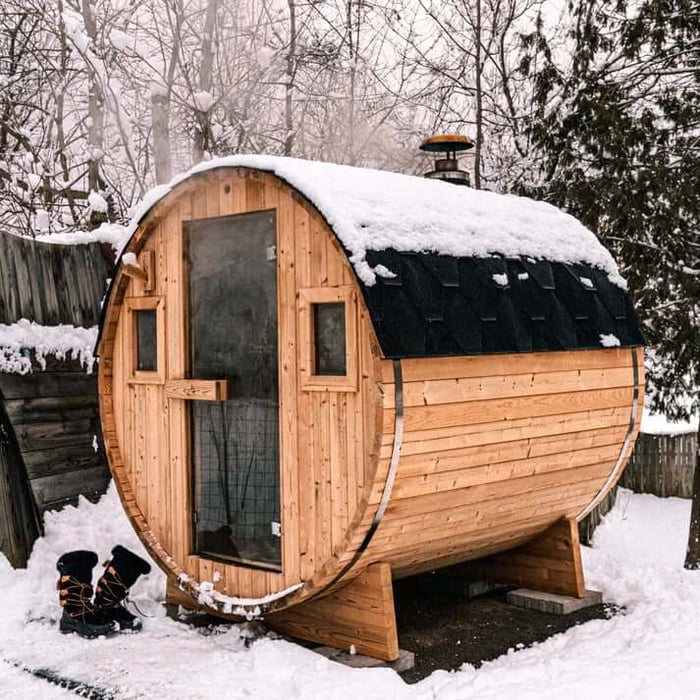
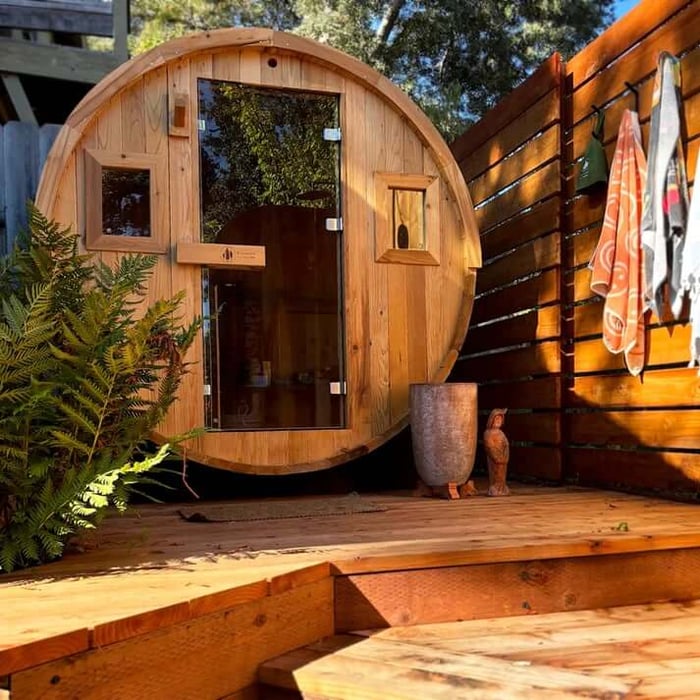
The Cabin (4-person) is the sweet spot for most Colorado households. It's spacious enough for two people to use comfortably with room to stretch out, sized appropriately for a typical backyard, and priced in the middle of the range. The Barrel saunas are a popular entry point and have a beautiful aesthetic, though note that the circular shape creates some uneven heat distribution, the Cabin's traditional rectangular layout heats more evenly.
Is It Worth Getting an Outdoor Sauna? Our Honest Take.
For health-conscious Colorado homeowners who commit to using it regularly: yes, an outdoor sauna is absolutely worth it.
The health benefits are real and well-documented including cardiovascular health, stress and cortisol reduction, athletic recovery, better sleep. For active Coloradans who push their bodies hard, it's one of the most effective recovery tools available. And unlike a gym membership, it's in your backyard at 9pm when you actually need it.
The keys to getting your money's worth:
- Place it close to your house with a clear, easy pathway
- Commit to at least two sessions per week and tie it to an existing routine
- Get the electrical work done right with a licensed electrician before installation
- Think through the full setup including leveling, decking, an outdoor shower, before day one
- Check your permit requirements with your local municipality
We ship our saunas throughout the continental US. For customers in the Denver metro and Front Range, South Table Sheds offers professional assembly, ensuring your sauna is properly leveled, sealed, and ready for its first session.
Browse our outdoor sauna collection
Get a free estimate for local assembly
South Table Sheds is based in Golden, Colorado. We sell premium outdoor structures nationwide and provide custom shed building and professional sauna and greenhouse assembly throughout the Denver metro and Front Range. Questions? Call us at 720-656-7313 or email amy@southtablesheds.com.
FAQs
How long does it take to heat up an outdoor sauna?
Most outdoor saunas with an 8kW Harvia heater reach optimal temperature (150–175°F) in 20–40 minutes depending on the size of the sauna, outside temperature, and insulation quality. The Wi-Fi enabled models let you start preheating remotely from your phone so it's ready when you are.
Can you use an outdoor sauna in Colorado winters?
Yes! And many owners say winter is their favorite time to use it. Colorado's cold, dry air actually makes the contrast between the heat inside and the crisp air outside incredibly invigorating. Your sauna will take slightly longer to heat up on very cold days, but a quality outdoor sauna built with solid wood construction handles Colorado winters without issue.
How many people fit in an outdoor sauna?
It depends on the model. South Table Sheds carries saunas ranging from 2-person models like the Duo all the way up to the 8-person Garden sauna. Most couples or small families find the 4-person Cabin is the sweet spot, spacious enough for two to stretch out comfortably, without taking up too much backyard space.
Does an outdoor sauna add value to your home?
Generally yes. Outdoor saunas are increasingly seen as a premium wellness amenity, similar to a hot tub or outdoor kitchen, and can make your home more attractive to buyers. The extent of the value added depends on your neighborhood and how well the sauna is integrated into the outdoor space.
How do I maintain an outdoor sauna?
Outdoor saunas are relatively low maintenance compared to other backyard structures. The basics include wiping down the benches and interior after each use, applying a UV-protective wood stain to the exterior annually, keeping the heater stones in good condition, and doing a light seasonal check on seals and vents before winter. Avoid harsh chemical cleaners inside, mild soap or a sauna-specific cleaner is all you need